2021 – 2022 · 0 → 1 · New Market
Business Tax
Piloted and scaled design for TurboTax's expansion into small business tax — a structurally different customer, domain, and expert network.


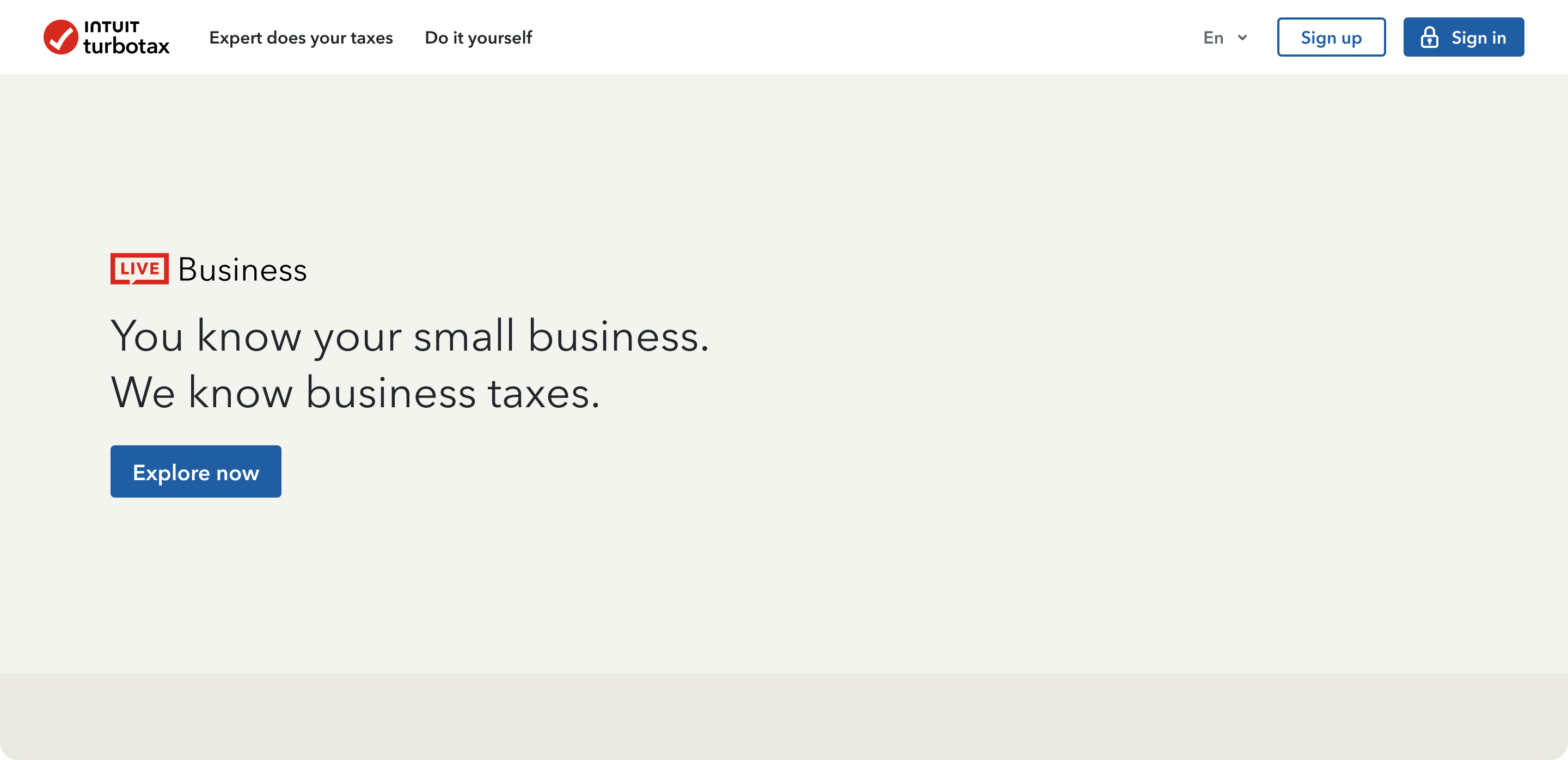

Small business owners had no good online option. And TurboTax knew it.
The only business tax experience in TurboTax's ecosystem lived on a desktop product customers had to buy on a disk. Cumbersome, high friction, and completely disconnected from the direction TurboTax was moving. Small business owners — a segment with real complexity and real willingness to pay for expert help — had nowhere to go online.
The goal was to change that. Launch both a Live Assisted offering, where an expert guides you through, and a Full Service offering, where you hand everything off to a pro. The market gap was real. The customer need was unmet. The only question was how fast the team could move to fill it.
We knew the skateboard wasn't perfect. We also knew it was filling a gap no one else had filled. That was enough to ship.
A zero to one launch, taken on as additional scope.
This wasn't a project with a dedicated team and a clean runway. It was additional scope on top of existing season commitments, with a tight timeline and no existing online product to build from. Contractor funding was secured to get boots on the ground, but the rest required significant coordination across teams and platforms throughout Intuit — stitched together through nights and weekends to make the timeline work.
The decision was made early to treat the first release as a skateboard: an imperfect but functional starting point that would prove customers were willing to use an online business tax product. That mindset gave the team permission to move fast without waiting for perfect. Piloted in 8 states with both assisted and full-service offerings, the launch generated real signal: who the customers were, what the baseline metrics looked like, and exactly what needed to improve for TY23.

Three design problems that made this genuinely difficult.
Porting the desktop experience to an online product surfaced challenges that weren't obvious upfront. Business tax is structurally different from consumer tax — the customers, the complexity, and the ecosystem all required new thinking.
Scope under pressure
Zero to one as additional scope, with limited resources and a fixed deadline. The team shipped knowing the experience wasn't fully baked — but understanding that filling the gap mattered more than waiting for perfect.
Entity type friction
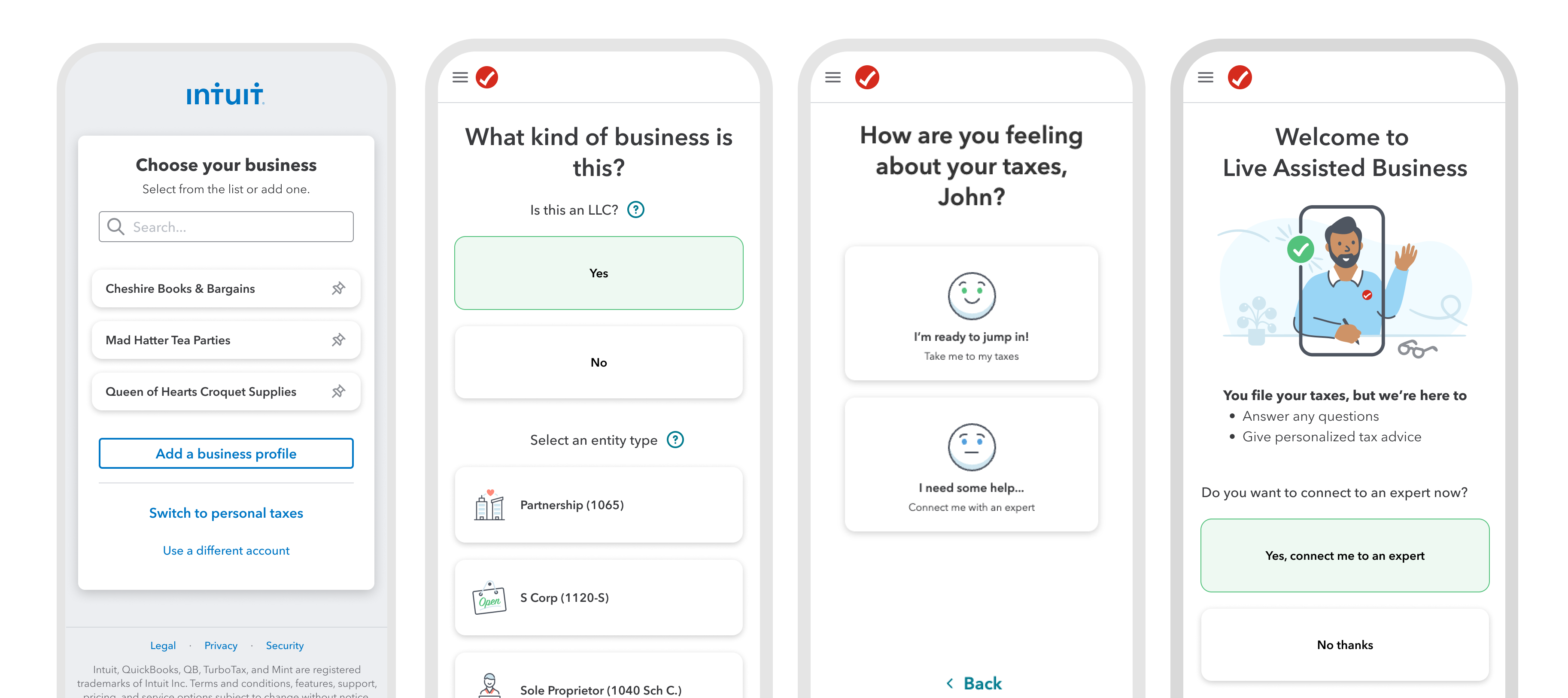
Business entity type isn't well understood by customers, but it has major implications for how they file. The questions required up front created too much friction out of the box and became one of the highest drop-off points in the funnel.
Identity complexity
Customers often already had personal TurboTax accounts. Recognizing whether they had an existing business account in the Intuit ecosystem, what type, and how to connect them required deep coordination across teams using a cross-platform realm concept.
What the pilot made possible.
The revenue and tNPS were encouraging for a first release. But the more useful output was what the data exposed, and the two offerings exposed very different things.
Full Service struggled to convert. The S2C rate came in at 1.2% against a 30% target, and 76% of customers who downgraded did so before ever connecting with an expert, meaning the product was losing people before the core value proposition even had a chance to land. The funnel pointed at two root causes: entity type confusion at the top, where nearly 40% of customers were out of scope or abandoned at that single question, and document collection in the middle, where the complexity of business taxes created a 22-hour average expert engagement and a 32-day average time to completion. The signal was clear. Full Service needed a lighter on-ramp and a cleaner handoff before it could scale.
Live Assisted told a different story. tNPS came in at 80.7, with promoters consistently calling out the expert experience as the reason they'd come back. The product worked when customers got through the funnel. The problem was getting them there. GTKMB represented 36.5% of all abandonment, Business Info another 23%. And 42% of completed units came after April 15 despite having no extension service at all, which meant there was a meaningful filing window the product wasn't built to capture yet.
Both pilots fed directly into TY23 planning: a Sole Prop / Schedule C offering to reduce GTKMB drop-off, LAB extension capability, a combined landing page to route customers into the right SKU earlier, and a pre-auth fix to reduce upgrade and downgrade churn.
The outcome
The skateboard became the foundation for one of TurboTax Live's biggest growth levers.
Figures reflect Live Assisted Business, the offering that scaled. Full Service ran as a learning investment: a deliberate bet to learn what an expert-led handoff would take before investing in it at scale.