2017 – 2020 · Product Strategy · Service Design
TurboTax Live: Assisted & Full Service
Designing two new expert-assisted tax products simultaneously — a 0→1 launch that became TurboTax's fastest-growing business and the company's current biggest bet.
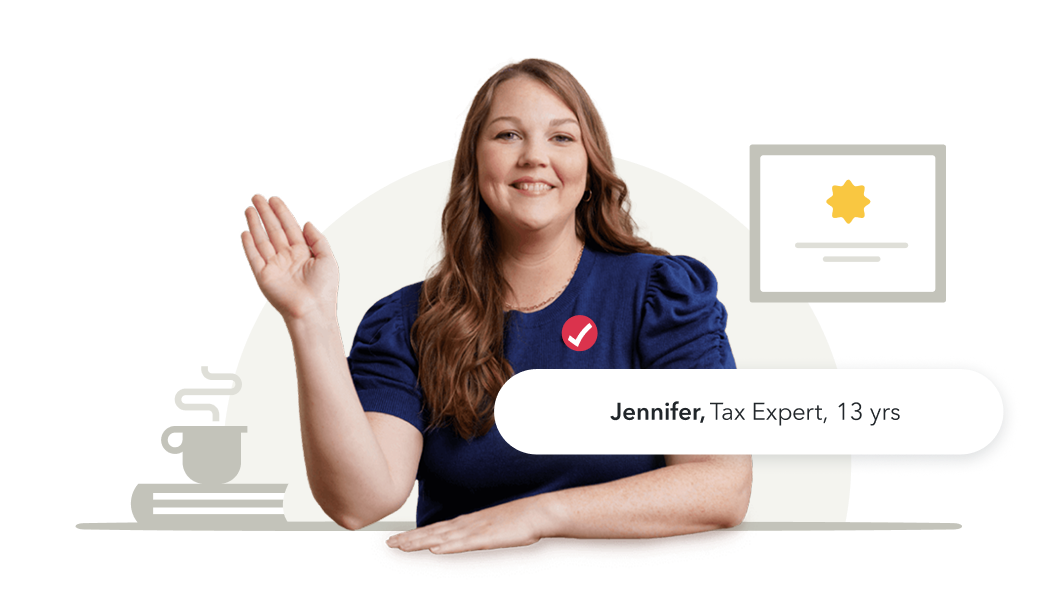

TurboTax was built for people who want to do their own taxes. Most people don't.
For decades, the product assumed a confident, self-sufficient filer. But the majority of Americans either pay someone to do their taxes or don't file at all — not because they lack the data, but because they lack confidence. TurboTax had no answer for them.
The challenge wasn't a feature gap. It was a category gap. We needed to design an entirely new kind of product — one that blended the software's efficiency with the trust of a human expert — without cannibalizing what made TurboTax successful in the first place.
We identified two customer mindsets with distinct attitudes and needs: "On the fence" and "Expert seekers"
Customers on the fence need expertise and reassurance to provide guidance while remaining in control. "I think our taxes are just too complicated now for us to do them ourselves. I want to make sure that we do everything right and get the most money back"
Expert seekers have no interest in using DIY software at all, and prefer to have an expert do their taxes from start to finish. Some require a desire of understanding and control, but not all.
These are two very different customer mindsets that we needed to address with our new pilots.
How do we expand our portfolio in order to capture more of our total addressable market beyond DIY?
Two products, one season, one team.
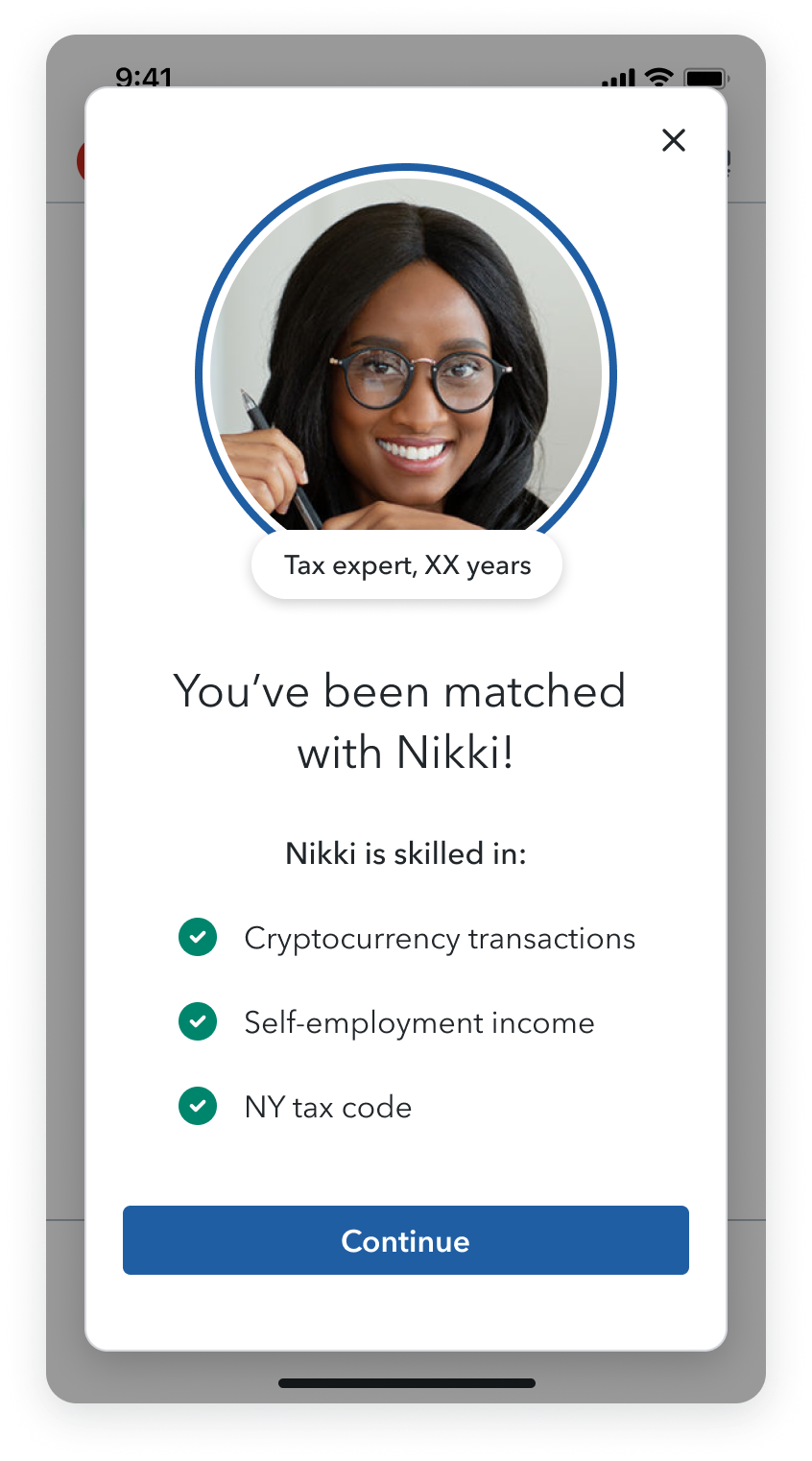
We launched TurboTax Live Assisted and TurboTax Live Full Service simultaneously — a deliberately aggressive scope. Assisted kept the filer in control with an expert available on-demand. Full Service handed the return entirely to a matched expert. They shared infrastructure but required fundamentally different design models.
I led the design across both, which meant defining not just screens but the underlying experience principles: how trust gets established, how handoffs between software and human should feel, how the expert network needed to be surfaced without overwhelming the filer.
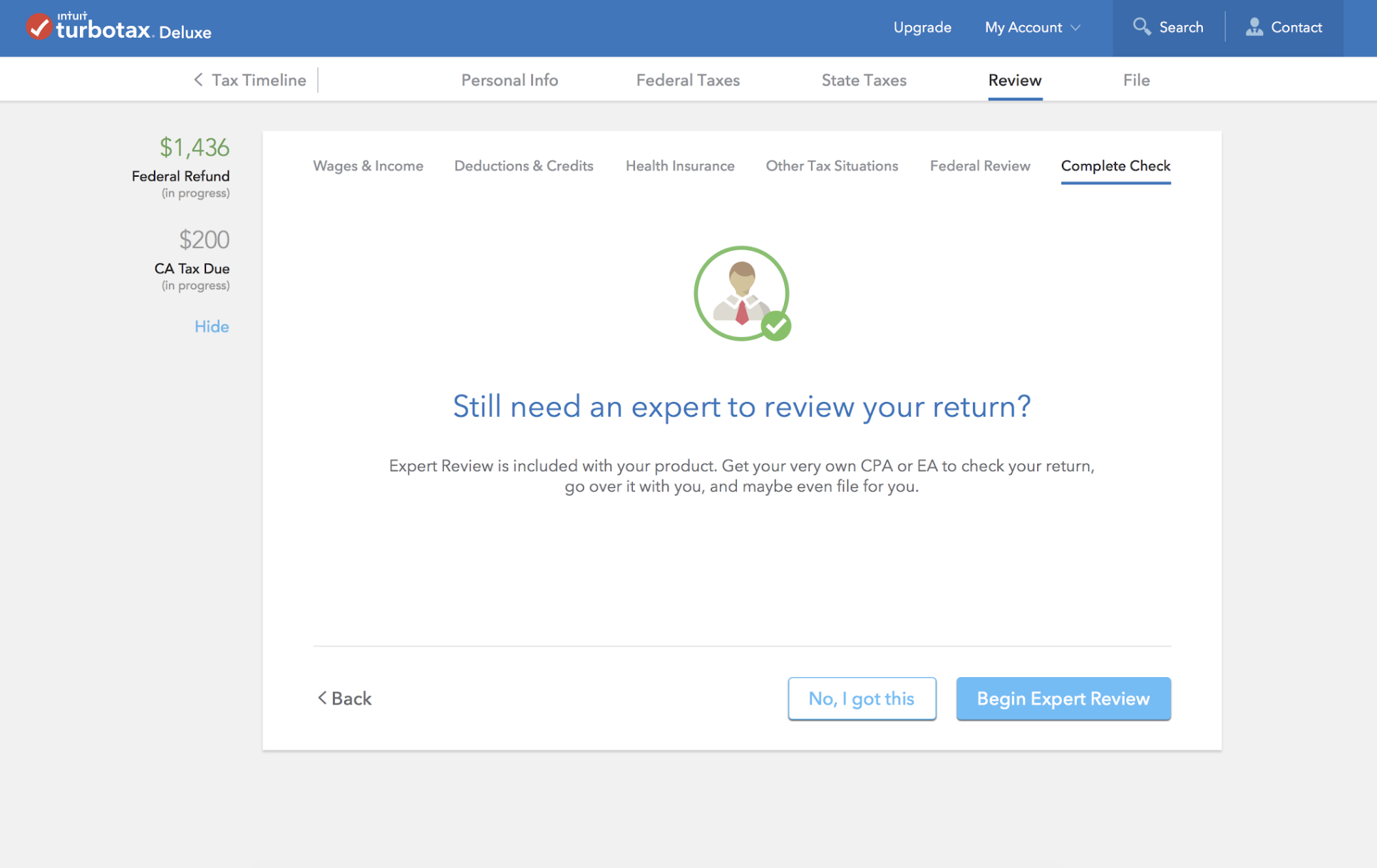
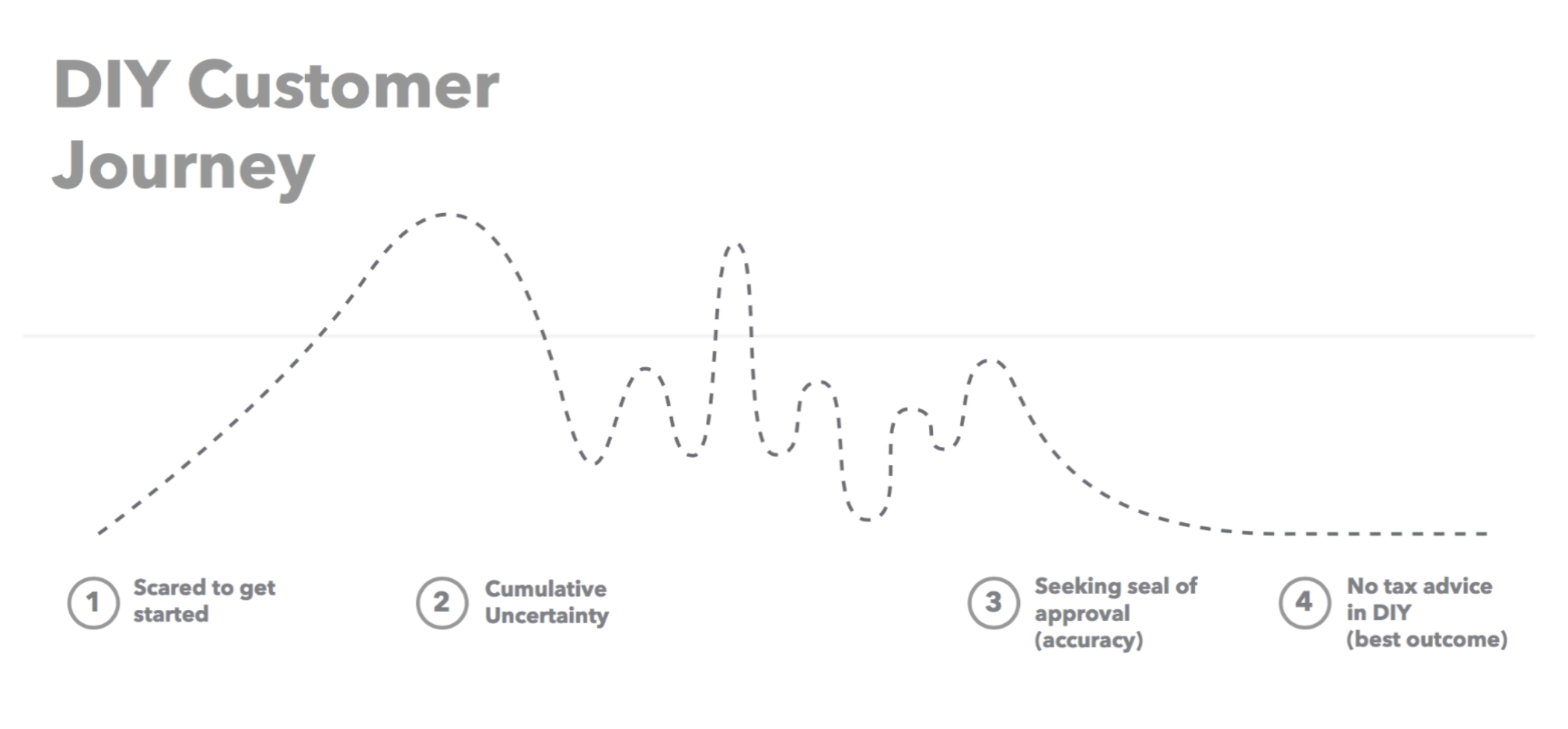
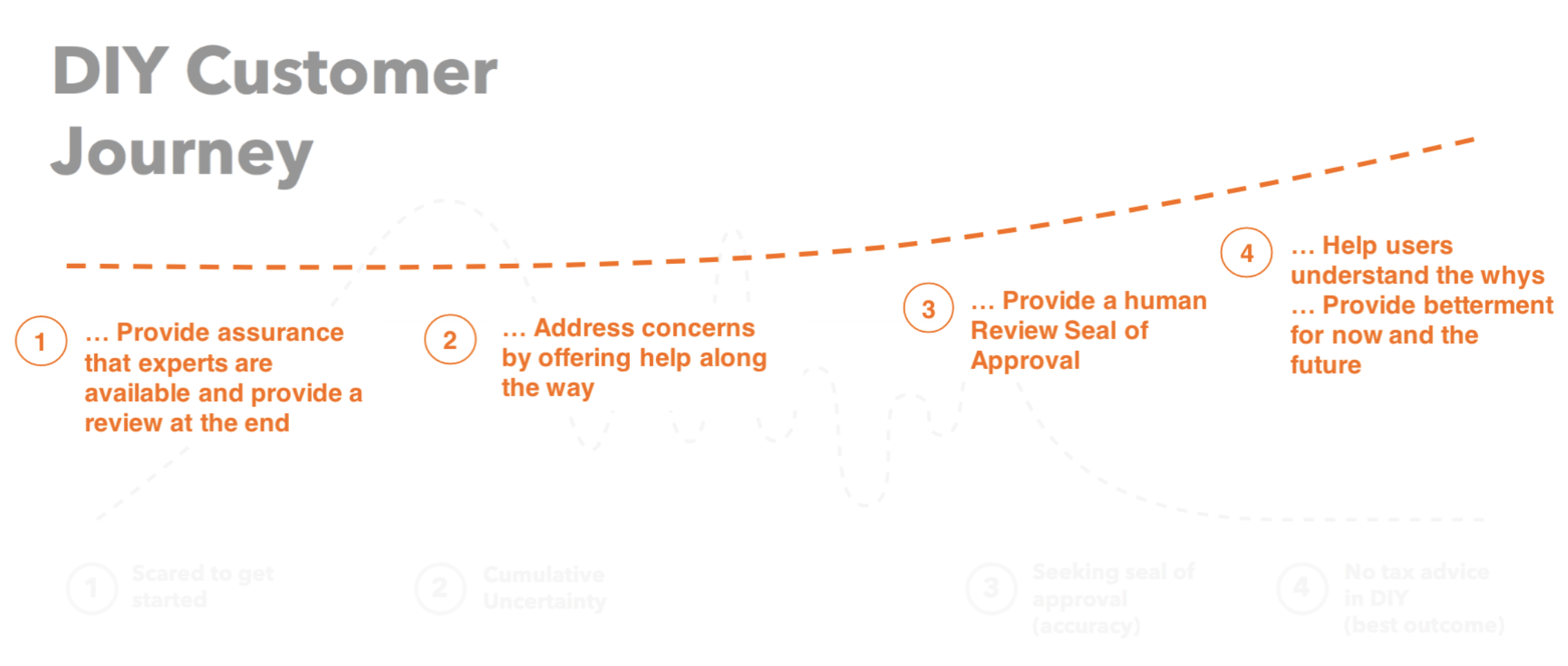
If we offer an expert review and advice along the eay, we can will consideration for users open to DIY
This was the leap of faith for our assisted pilot, aka 'Do it with me'. The way to think of this offering, is that it's a service layer that sits on top of our core DIY product. So we would speak to customers that were on the fence about using TurboTax for two main reasons: they've used DIY software before but had a one-time or new-normal life change, or they've never used it and are considering to try, but are afraid of making a mistake.
The former has specific fears and doubts relating to their situation, the ladder has overall general fear that prevents them from even starting. Below you can see pain points that an 'On the Fence' customer would have when considering trying tax software. There is friction to start, before they even begin to look. So we really needed to make sure our promise to payoff was strong.
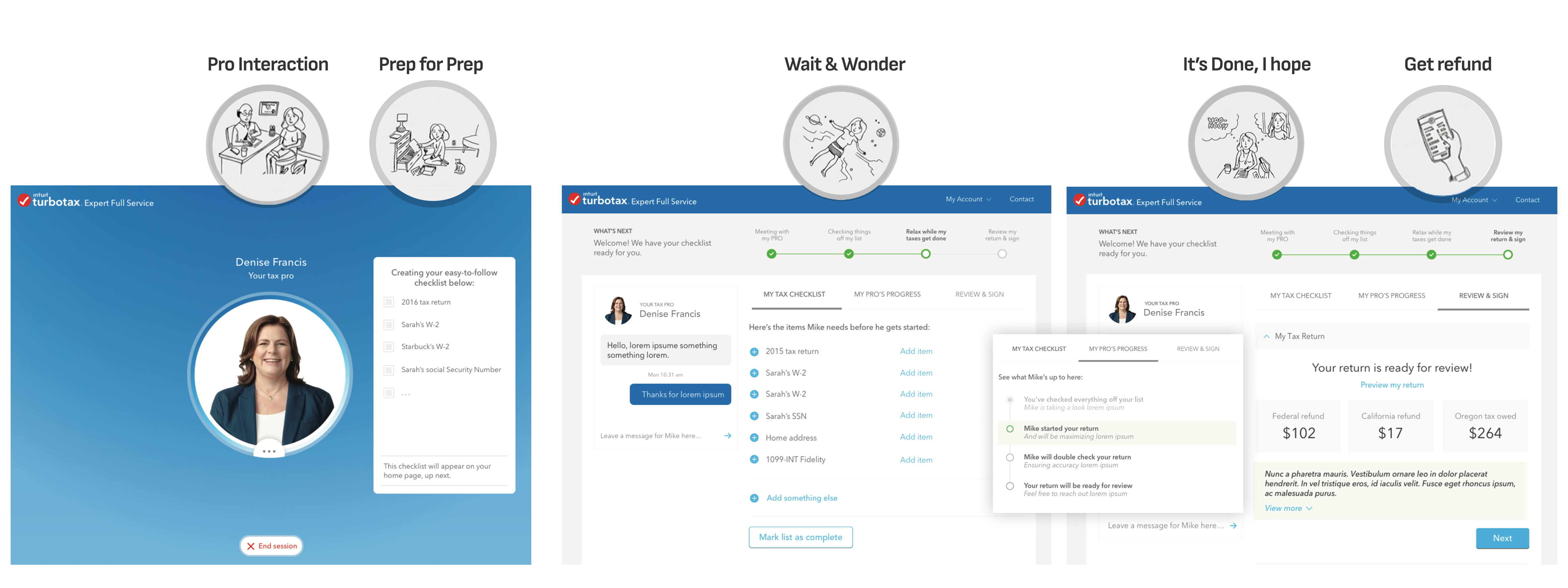
After many rounds of scrappy prototyping with customers, leveraging Design 4 Delight, we landed on a few key execution components. We knew we needed to nail the uncertainty of how to prepare, the warmth of the service, and the wait & wonder period that is so common with the classic paradigm.
Lean into pro interaction
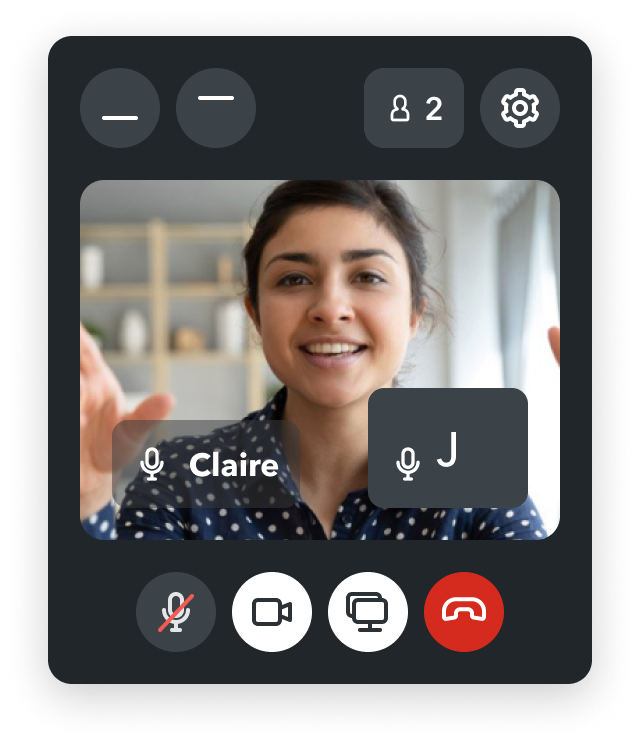
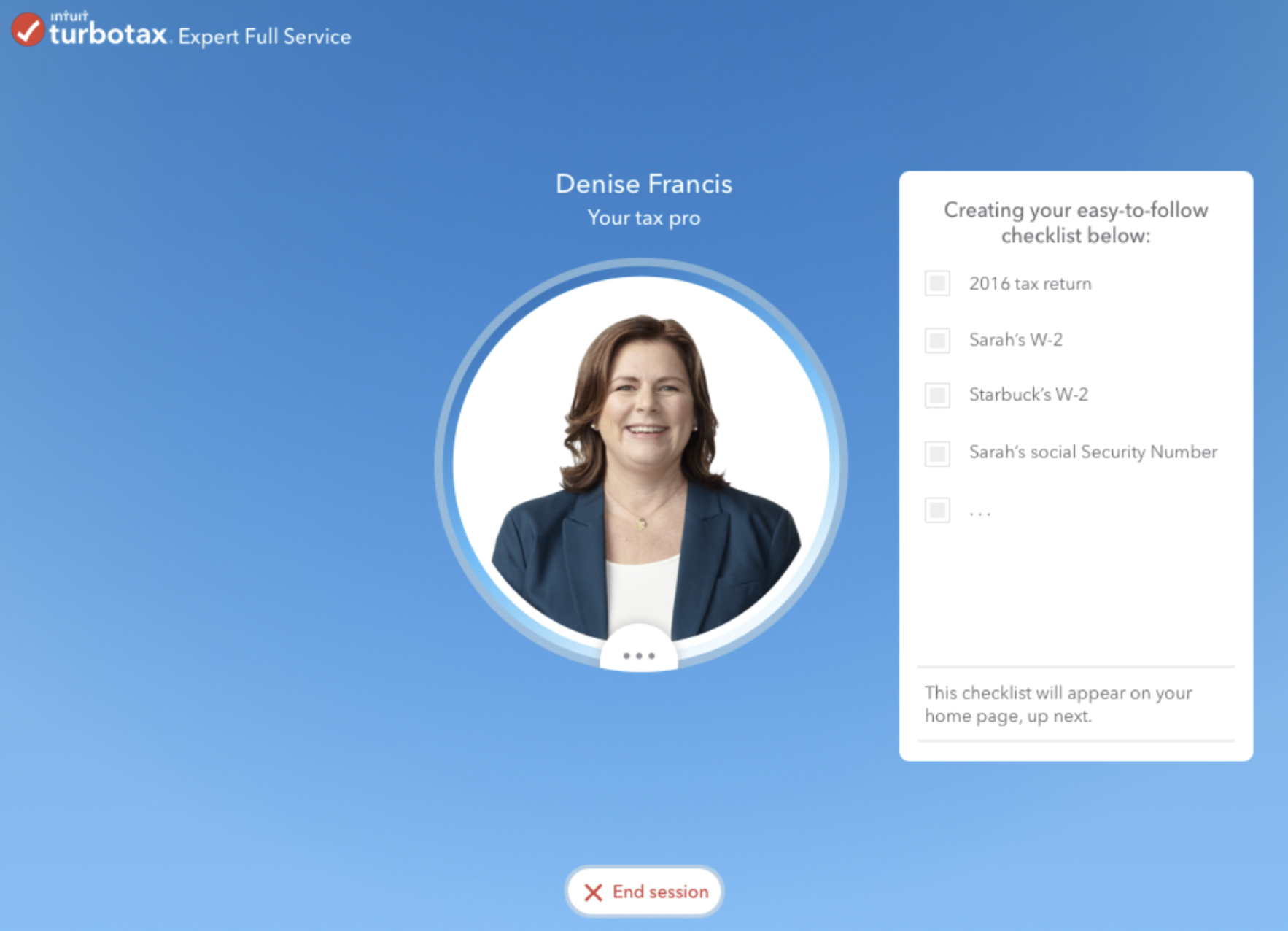
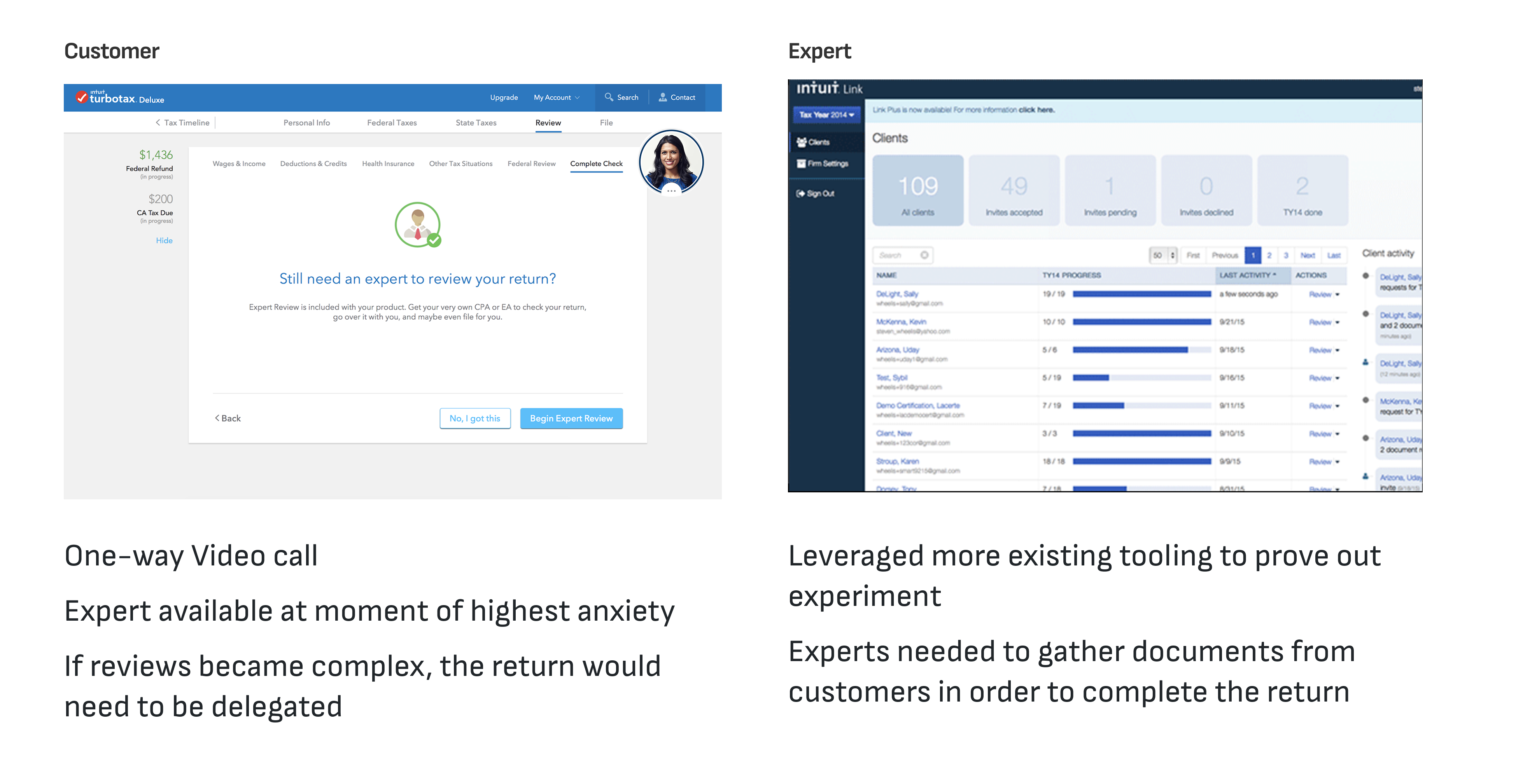
We leveraged a technology called SmartLook that allowed for one-way video. This was intentional so the expert could be seen on video, but the customer could be in their PJ's if they wanted.
Nail prep-for-prep with a checklist
The checklist feature was built in realtime during the conversation so the customer would know exactly what was needed, based on their unique tax situation. They also felt heard and seen, which was important.
Scheduling & async messaging
We needed customers to know we worked around their schedule, not the other way around. We built the tools to make them feel in control, and always knew what the status of their return was based on our "pizza tracker" progress bar.
The teams worked cross functionally, partnering closely with service design, customer success, operations, and the experts themselves, mapping everything out on swimlanes to make sure every touchpoint was considered. At the same time, we had a short runway, and velocity/shipping was most important to get learnings, so a lot of this had to happen in parralell.
Our bets were on Full Service.
My role during the launch of these pilots was design lead, and had two small scrappy teams that worked across each of these pilots consisting of product design, content design, and research.
Our approach was to deeply understand who this customer was by doing interviews, and to learn what pain points existed in the current process of visiting a tax pro, or going to a tax store like H&R Block. After many rounds, we were able to map them out and used a simple artifact
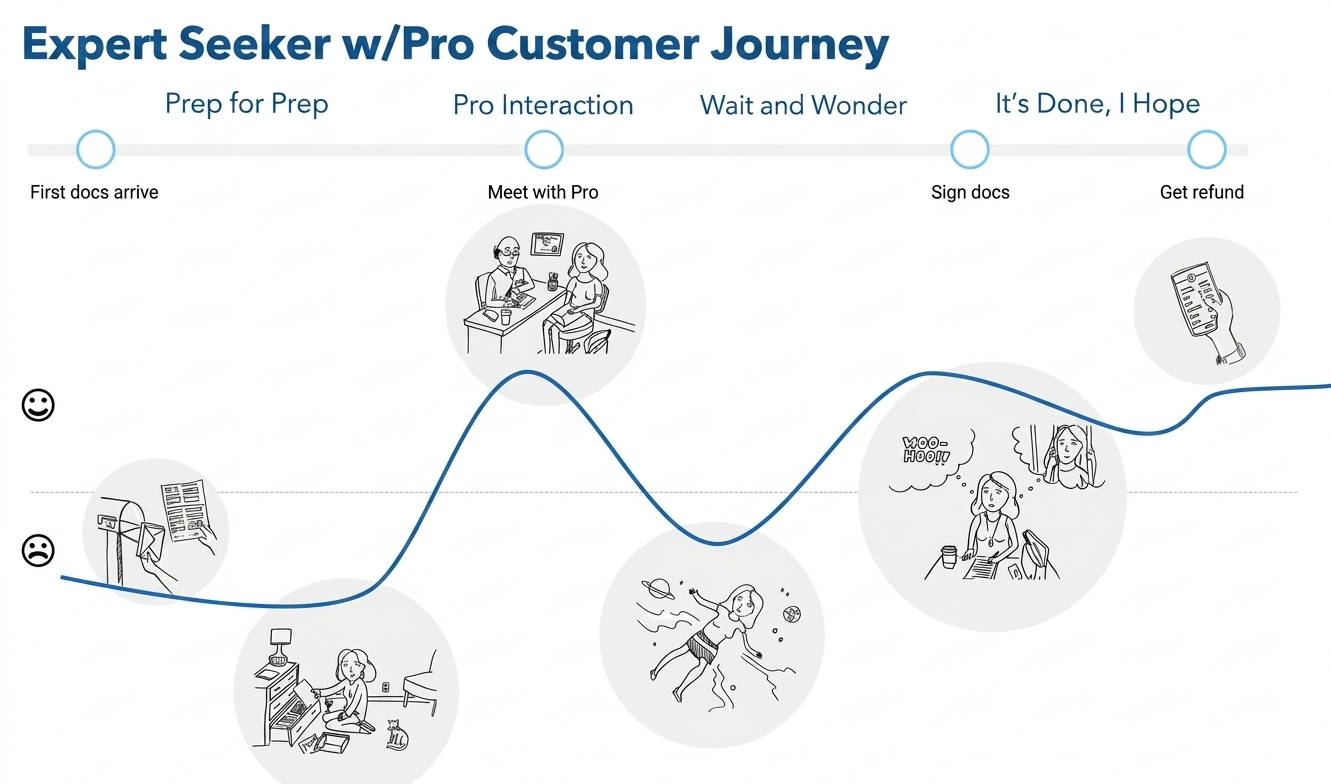
After many rounds of scrappy prototyping with customers, leveraging Design 4 Delight, we landed on a few key execution components. We knew we needed to nail the uncertainty of how to prepare, the warmth of the service, and the wait & wonder period that is so common with the classic paradigm.
Lean into pro interaction
We leveraged a technology called SmartLook that allowed for one-way video. This was intentional so the expert could be seen on video, but the customer could be in their PJ's if they wanted.
Nail prep-for-prep with a checklist
The checklist feature was built in realtime during the conversation so the customer would know exactly what was needed, based on their unique tax situation. They also felt heard and seen, which was important.
Scheduling & async messaging
We needed customers to know we worked around their schedule, not the other way around. We built the tools to make them feel in control, and always knew what the status of their return was based on our "pizza tracker" progress bar.
The teams worked cross functionally, partnering closely with service design, customer success, operations, and the experts themselves, mapping everything out on swimlanes to make sure every touchpoint was considered. At the same time, we had a short runway, and velocity/shipping was most important to get learnings, so a lot of this had to happen in parralell.
The surprise: we bet on the wrong horse.
Full Service was our moonshot. The fully-delegated model felt like the future. Hand your taxes to a matched expert and walk away. We put significant energy into it.
But the pilots told a different story.
In year one, Full Service yielded only a few thousand units. Expert Review, the scrappier software-first bet, came in at nearly 500,000. Customers who were on the fence didn't want to fully let go. They wanted a safety net, not a handoff.
It was humbling and clarifying at the same time. We'd built the right product for the wrong customer. And the data told us exactly where to double down.
From pilot to TurboTax's biggest growth lever.
The Assisted model scaled fast. In year two it grew 3x, and what started as a scrappy experiment became the fastest-growing segment in TurboTax history, eventually reaching $2B+ in revenue and representing over half of TurboTax's total revenue trajectory.
Full Service didn't disappear. It matured into its own product line with a dedicated customer base. But the sequencing mattered: we learned what "trust" actually meant to each customer type, and that shaped everything that came after.
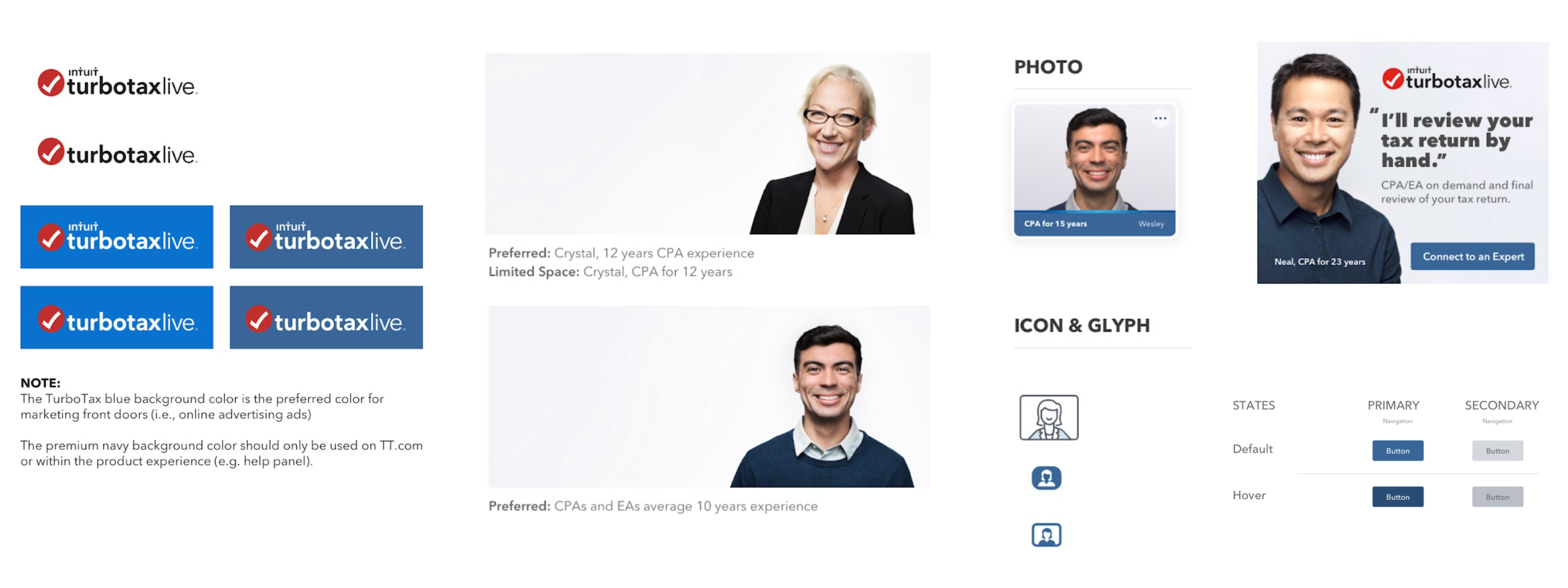
Scaling also meant building what hadn't existed before: a complete brand system for TurboTax Live. Logo, color, typography, photography direction, credential display, iconography. We needed customers to recognize the product as distinct, not just a feature of TurboTax, but a service with its own identity and promise.
We called the core design challenge the "ownable moment": designing the full arc from what we promised in marketing to what customers actually experienced at the end. If the promise and the payoff didn't connect, we hadn't earned their trust, we'd just rented it.
A 0 to 1 that became the company's biggest bet.
TurboTax Live went on to win the Scott Cook Innovation Award, Intuit's highest recognition for product impact. More importantly, it fundamentally changed the trajectory of the business, opening up a segment TurboTax had never been able to reach before.
Looking back, the thing I'm most proud of isn't the revenue number. It's that we ran two very different design experiments simultaneously, learned fast, followed the signal, and built something durable. That's the work.
The outcome